
VCCW Release Destinations
A woman leaving Virginia Correctional Center for Women may be discharged from her prison term, released on parole, or placed on post-release supervision. Parole is discretionary early release for a person who is legally eligible. Post-release supervision is a court-linked period under VADOC Community Corrections. Discharge means the correctional obligation identified by the record has ended, though a separate case or authority can still matter.
A move from VCCW to another VADOC institution, work center, hospital unit, or outside authority is a transfer. It ends custody at this building but not VADOC custody. The VADOC locator’s status and location, release paperwork, and receiving agency must agree before the event is described as community release.
| Event | Where to verify |
|---|---|
| Discharge | VADOC release event and signed release documents |
| Parole or supervision | VADOC locator, conditions, and assigned supervision office |
| VADOC transfer | New locator location and institutional record |
| Outside-agency transfer | Receiving authority named in the custody record |
Confirm a VCCW Release
The official VADOC Inmate and Supervisee Locator is the correct first search. Enter the seven-digit DOC ID when known. Otherwise, supply at least the first three letters of the first name and the full last name, then narrow by location, race, gender, or age. Accept the disclaimer and match identifiers with care.
- Open the VADOC locator and search by DOC ID or supported name fields.
- Determine whether the result describes an inmate, supervisee, or another displayed category.
- Read the location and release-date label literally. A future date is a current calculation, not completed release.
- Compare the locator with the Order of Release, notification-of-release letter, or Conditions of Parole or Probation.
- For an older or disputed event, request the specific VADOC custody and release record.
VADOC says locator data is updated daily and may still be inaccurate or out of date. If no match appears, do not infer that the person was never in VADOC. Historical records may require a targeted request. A woman who served only a local Pamunkey sentence may never appear here.
VCCW Release Date Evidence
The locator can display a release date while a person remains incarcerated. That date is projected in the ordinary sense because sentence credits, discipline, jail credit, amended court orders, detainers, and other events can change the calculation. The actual release is established later by the facility event and formal documents.
VADOC’s facility release instructions state that release occurs by 11:59 p.m. on the release date, weather permitting. A date shown early that day does not prove the person has left VCCW. Staff prepare a notification-of-release letter and, as applicable, an Order of Release, Conditions of Probation, or Conditions of Parole. The person and a staff witness sign and date the applicable papers.
A sentencing order proves judicial authority. It may not show the hour VCCW completed the physical release. Use both records when precise timing matters.
VCCW Records and Contact
VCCW is listed through the official VADOC Facilities and Offices directory. The institution can route a facility question, while VADOC’s central records route is better for a historical custody or discharge entry.
Virginia Correctional Center for Women2841 River Road
Goochland, VA 23063
804-556-7500 Virginia Department of Corrections
P.O. Box 26963
Richmond, VA 23261
804-674-3000
docmail@vadoc.virginia.gov
Monday through Friday, 8 a.m. to 5 p.m.
Give the seven-digit DOC ID, full name, VCCW, the relevant date range, and the exact record sought. Ask for custody dates, release or discharge date and type, and release documents if releasable. Exclude medical, victim, security, presentence, and other protected material. A focused request is easier to match and review than a demand for a full file.
VCCW and Goochland Custody
VCCW’s place in Goochland creates the county’s most common facility error. The prison is physically in Goochland, yet it does not function as the county jail and does not chiefly hold people arrested in Goochland. Its population is statewide. Conversely, Pamunkey Regional Jail is in Hanover but officially houses Goochland detainees.
That inversion should decide the search before a name is typed. Use Pamunkey, Virginia Jail VINE, and Goochland courts for an ordinary local jail episode. Use VADOC for VCCW. A county roster may have ended months or years before a woman arrived at VCCW, so it cannot prove her later state-prison release.
The Goochland release-record overview maps county, state, federal, and immigration paths. Do not merge their IDs: a Pamunkey inmate number, VADOC DOC ID, court case number, BOP register number, and ICE A-number belong to different systems.
VCCW Notification After Release
State-prison notifications use VADOC’s NAAVI program. Eligible registered victims may receive notices for events such as advanced release, actual release, transfer, work release, escape or recapture, parole interview, and parole decision. Registration is separate from Virginia Jail VINE.
If a woman moved from Pamunkey to VCCW, an earlier local-jail VINE registration does not automatically follow her. An eligible person must use the VADOC victim notification route or contact Victim Services at 804-674-3243 or 800-560-4292. Notifications should still be checked against the locator and formal release record because an alert can describe a transfer rather than release to the community.
- Jail VINE
- Search and alert system for Virginia local and regional jail custody.
- NAAVI
- Separate VADOC notification program for eligible registered victims.
- Supervisee
- A person managed in the community under VADOC conditions.
- Detainer
- A request or hold that can cause transfer to another authority.
VCCW Supervision Records
A woman may leave the secure VCCW facility and remain under VADOC control in the community. The matched locator result can show supervision rather than incarceration. Her signed conditions identify reporting duties and the assigned officer or district. For public confirmation, use the current VADOC office directory because office listings can change.
Goochland is served by Probation and Parole District 9, named Charlottesville. That office covers several localities. VCCW itself is not the local walk-in probation and parole office. A supervision status does not mean the entire sentence has been discharged, and a missed appointment rumor does not prove an absconder warrant. Verify a warrant with the issuing court or law enforcement.
For a disputed time calculation, correspondence belongs with the VADOC Correspondence Unit and Court & Legal Section at P.O. Box 26963, 6900 Atmore Drive, Richmond, VA 23261. Do not rebuild the release date from sentence length alone.
VCCW Facility Release Image
The official VADOC facilities directory shows the VCCW listing and the state office context used for a release search.
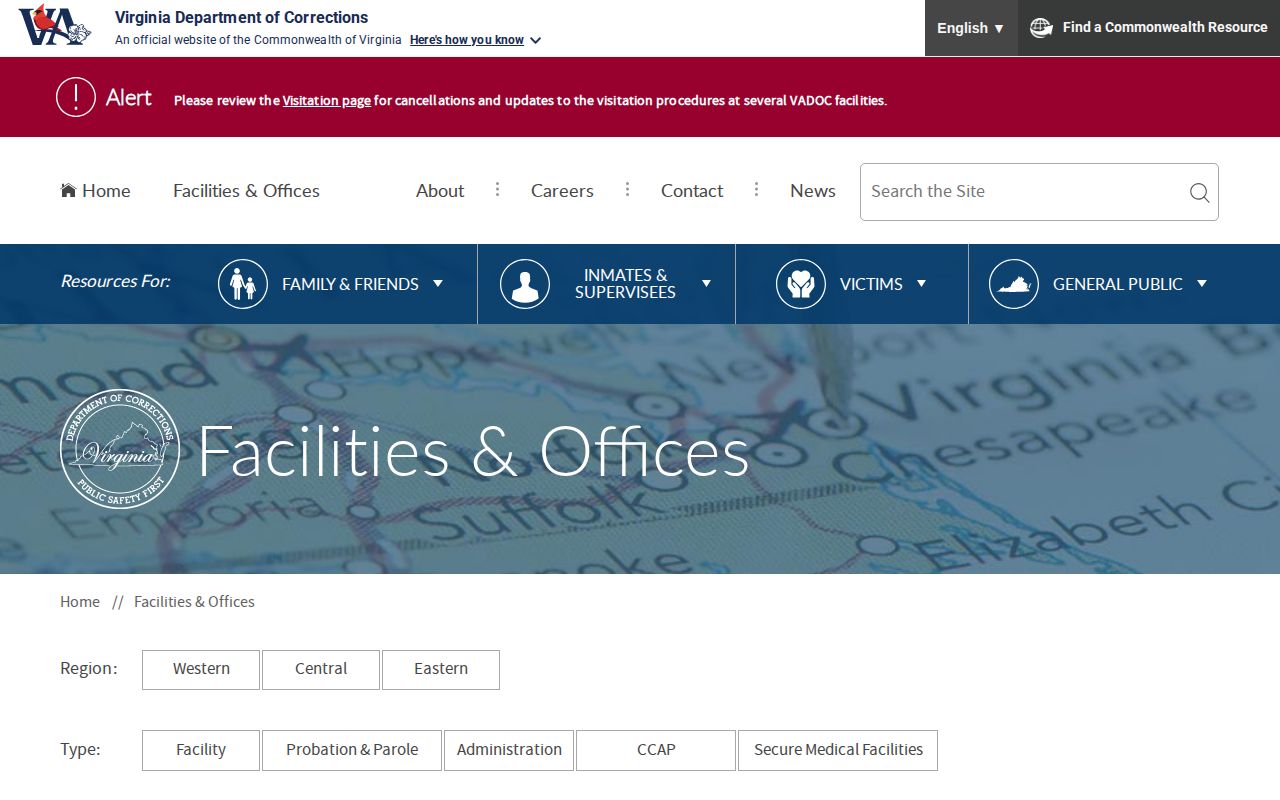
The directory view reinforces that VCCW is a VADOC state prison and that community-supervision contacts are separate from the prison itself.
VCCW Time Computation Records
Virginia’s earned-credit rules do not support one universal release percentage. VADOC’s time-computation material separates ESC-1 and ESC-2 categories. Certain listed offenses are capped at 4.5 credits per 30 days served, while other eligible sentences can earn through a level system up to 15 days per 30 days. Offense exclusions, conduct, participation, effective dates, and other statutory conditions matter. A rough “85 percent” label applies only as shorthand for one maximum-credit class.
VADOC calculates active earned-sentence-credit terms longer than 12 months. The department lists pre-reception jail time, sentence type, total active sentence, credit class levels, disciplinary offenses, and other events as variables. Consecutive or concurrent terms, amended orders, jail credit, escape time, and detainers can also change the operational date. A VCCW locator result should therefore be read as the department’s current public calculation while incarceration continues.
The person can direct a computation inquiry to the VADOC Correspondence Unit and Court & Legal Section. A third party should not attempt to reconstruct the date from an arrest article or sentence length. The sentencing order, computation record, and later release documents answer different parts of the question and should be reconciled by identifier.
VCCW Release Record Fields
A focused historical request should ask for the admission and custody dates, VCCW location period, release or discharge date, release type, and receiving or supervision authority. Include the seven-digit DOC ID. Ask for the notification-of-release letter and applicable order or conditions if those documents are releasable. A photograph may help identify the matched state record, but it does not prove release.
Request redaction of protected information rather than demanding medical, victim, presentence, or security material. If the record shows a transfer, follow the named location instead of calling it discharge. If it shows supervision, use the assigned office and conditions to verify the next stage.